


Australia’s residential landscape is full of sloping blocks. From the hilly suburbs of Brisbane’s inner north and south, to the escarpment-edged streets of Sydney, the undulating terrain of Melbourne’s outer east, and the ridge-top lots that define so much of Southeast Queensland’s character – building on a slope is an everyday reality for a significant proportion of Australian homebuilders.
And yet, sloping blocks consistently catch homebuilders off guard. The costs are higher, the design is more complex, and the margin for error is smaller. A detail survey, completed early and comprehensively, is the single most important step you can take to understand what you’re working with – and to avoid the expensive surprises that derail so many sloping block builds.
Why Sloping Blocks Are Different
On a flat block, the relationship between the land and the building is relatively straightforward. The site is prepared, the slab is poured, and construction proceeds with few site-specific complications.
On a sloping block, almost every decision is more nuanced. Where the building sits on the slope affects how much earthworks are required. How the floor levels are set affects stormwater drainage, council compliance, and the internal amenity of the home. How the slope is managed at the boundaries affects retaining walls, neighbouring properties, and long-term maintenance. None of these decisions can be made well without accurate information about the land – and that’s exactly what a detail survey provides.
What a Detail Survey Reveals on a Sloping Site
A detail survey on a sloping block captures far more useful information than most homebuilders initially expect. Beyond the basic features of the site – boundaries, structures, trees, and services – the contour component of the survey reveals the true shape of the land in a way that no site visit or photograph can replicate.
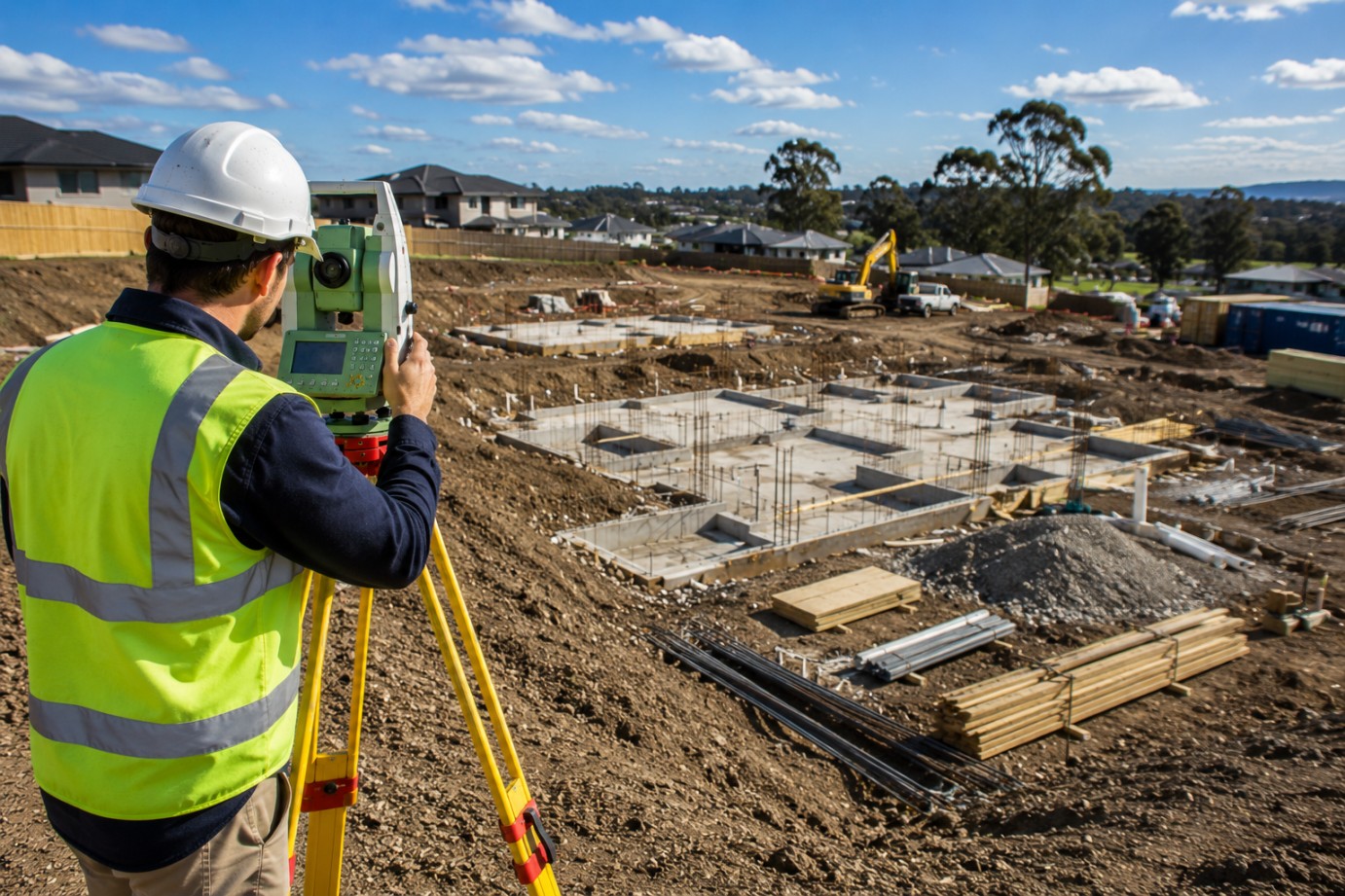
Specifically, a detail survey on a sloping block will show:
The rate and direction of fall. Contour lines make it immediately clear how steeply the land drops, in which direction, and whether the slope is consistent or variable across the site. This information directly informs where the building can be positioned and how earthworks will need to be managed.
Level changes at the boundaries. On sloping sites, the relationship between your land and the properties adjoining it is particularly important. A detail survey captures the levels at and near the boundaries, revealing whether your site sits higher or lower than your neighbours – which has direct implications for retaining walls, drainage, and the potential for water to flow between properties.
Existing retaining walls and structures. Many sloping blocks already have retaining walls in place, either from previous development or from the original subdivision works. A detail survey records their position, length, and the level change they’re managing – information that’s essential for understanding what’s already on site and what condition it’s in.
Drainage patterns. Water follows the path of least resistance, and on a sloping site that path is often directly through your building envelope. A detail survey allows engineers to model exactly where stormwater will travel across the site, identify any low points where water may pool, and design a drainage system that manages runoff effectively.
The Cost Implications of Getting It Wrong
Sloping blocks have a way of revealing expensive problems at the worst possible time – during construction, when options are limited and costs are at their highest. The most common issues that emerge from inadequate site information include:
Earthworks volumes that are significantly higher than quoted, because the site levels weren’t accurately known when the builder priced the job. Retaining walls that are needed but weren’t budgeted for, because the relationship between the building platform and the boundary wasn’t understood. Drainage systems that don’t work as designed, because the actual site levels differed from what was assumed. Floor levels that don’t comply with council requirements, because the survey data used during design wasn’t accurate enough.
Every one of these problems is avoidable with a comprehensive detail survey completed before design begins.
Choosing the Right Contour Interval
On a sloping site, the contour interval used in the survey matters more than it does on flat ground. A coarse interval – say, 1 metre – may be adequate for a broad understanding of the topography, but it can miss the subtle variations that affect drainage design, floor level setting, and earthworks planning.
For most residential sloping blocks in Australia, a contour interval of 0.2 or 0.5 metres is recommended. This level of detail gives your architect, engineer, and builder the precision they need to make good decisions – and to price the project accurately before construction begins.
If you’re unsure what interval is appropriate for your site, discuss it with your surveyor at the time of briefing. A good surveyor will ask about the intended use of the survey and recommend the approach that best serves your project.
Working With the Slope, Not Against It
One of the most valuable things a detail survey enables on a sloping block is the opportunity to design with the land rather than against it. Architects and designers who have accurate contour data can explore building forms and orientations that work with the natural fall of the site – splitting levels to follow the slope, positioning living areas to capture views, and minimising earthworks by placing the building where the ground already wants to be.
This kind of design thinking produces better homes and lower construction costs. But it’s only possible when the design team has the accurate, detailed site information that a professional detail survey provides.
The Bottom Line
Building on a sloping block in Australia is entirely achievable – and can produce some of the most interesting and rewarding homes imaginable. But it demands more careful planning than a flat site, and that planning has to start with a thorough understanding of the land.
A detail survey is how you get that understanding. Commission one early, brief your surveyor thoroughly, and make sure your entire design and construction team is working from the same accurate picture of your site. The investment is modest. The alternative can be very expensive indeed.
